2026

Reflection as a family ritual:  What was the highlight?

Looking back on raising my daughters, one tradition stands out: reflection.   Even when they were little, after bedtime stories and cuddle time and the final switch-off of the light, my last question each night would be, What was the highlight of your day? It gave them pause. A small moment to look back and recognise what had been good. Some highlights were bigger than others — an adventure, a playdate, an outing, an activity they’d been excited about. Other times it was something small: a rainbow, a treat, a bubble bath, a joke in the car. And that was the point. The highlight didn’t have to be dramatic. It just had to be noticed. I would always follow it with, And what are you looking forward to tomorrow? So they went to sleep thinking forward. Anticipating. Imagining. Drifting off in a positive frame of mind, already leaning into the next day. We carried this into family holidays as well. At the end of each day we’d ask again — what was the highlight? Sometimes it was something spectacular: a special animal sighting in a national park, a landscape that took our breath away. Other times it was an unusual find — a tiny, fascinating museum no one expected, a great street meal, getting caught in the rain on the beach and laughing about it afterwards.    And of course, the highlights were different for each person. That in itself is interesting. One child might choose the dramatic moment; another might choose the small detail — a particular bird, even a dung beetle rolling its treasure across the sand. What we notice says something about how we see the world. I carried the tradition into New Year’s Eve. Every year, I gather the family — and often friends too — and I ask the same question: What was the highlight of your year? Not all years are easy. Some are tough. But there is always something good to be found. Even in 2020 — which, globally, was heavy — we found highlights. Long chats around the fire during lockdown. A slightly chaotic mask-making business. Discovering new music because we were bored of our old playlists. Unexpected pockets of family time that we might otherwise have rushed past. The question itself is simple.   What was the highlight of your day? Your holiday? Your year?   But it creates a habit of noticing; of savouring; looking for the good, even when the year has been uneven. It has become a treasured tradition in our family. I hope my daughters carry it forward in some shape or form, and perhaps adapt it in their own way. It has already spread quietly to friends, who always join in when they’re here. Questions and reflections—always something to ponder.

Reflection as a family ritual:  What was the highlight? Read More »

Movie Nights

One thing I discovered about myself in 2020, during lockdown, is… ..that while I always thought I wasn’t a collector of anything, it turns out I am a collector of movies. It surfaced during those long stretches of online chats when everyone was looking for things to do with their families while stuck at home. At some point I mentioned that I had a fairly extensive categorised list of films we had watched over the years, and before I knew it I was sharing that list with friends or even online groups who were trying to entertain multi-generational households under one roof. For me, Friday night movie night had been far more intentional than perhaps other families experienced. With my husband working away and only home every two to three weeks, the girls and I had long stretches of it just being us. When they were little, Friday nights meant Disney and popcorn and all the usual favourites. But as they grew older, I became much more discerning about what I put in front of them. We absolutely watched plenty of fun, light entertainment (Secondhand Lions; The 100 Foot Journey; Men in Black; Pirates of the Caribbean, being favourites). But in between those, I deliberately positioned more thoughtful films — stories rooted in history, resilience, context, and real human experience. Seven Years in Tibet opened conversations about the Dalai Lama and the Himalayas.   The Pursuit of Happyness gave us a lens into perseverance and fatherhood.   Breathe (2017), about Robin Cavendish and the impact of polio, sparked long discussions afterwards.   The Man Who Knew Infinity introduced Ramanujan and mathematics in a way school never quite does.   A United Kingdom brought history, love and courage into the lounge. These were not heavy-handed “lessons”, but they did invite reflection. Often we would read up afterwards, or chat, or simply sit with what we had watched. I realised that this rhythm quietly built general knowledge and, perhaps more importantly, helped the girls learn to engage with what they were watching instead of just consuming it.   I do remember one of their friends joining us for Breathe. Afterwards she said, slightly wide-eyed, “I think I’m traumatised.” They weren’t used to that kind of fare at home. But my girls took it in their stride. They were comfortable engaging with harder themes, different contexts, bigger ideas.   These days it’s more complicated. They’re young adults now, with their own lives, and streaming services mean everyone can watch whatever they like, whenever they like. But I still occasionally round them up and announce, “Right, it’s family movie night.” Pizzas go in the oven; popcorn gets made; blankets unrolled, and we sit together again.   I still add to my list app when I come across something worthwhile. It seems I am, after all, a collector, and I still share my collection with anyone who wants to the same joy we had. Download Movie List

Movie Nights Read More »

From Family Questions to Campfire Conversations

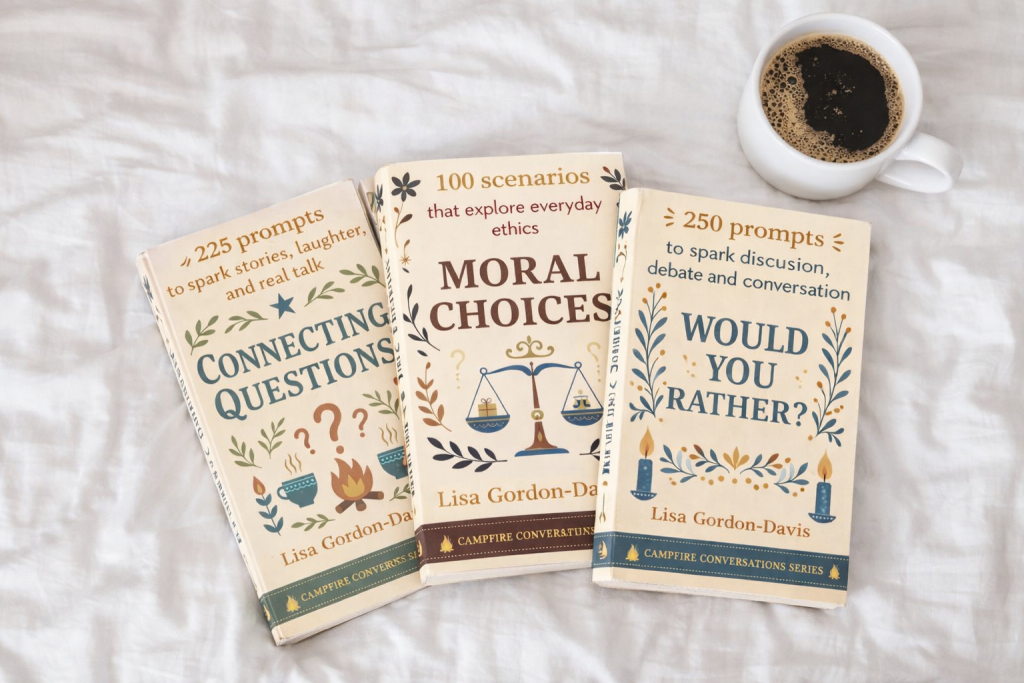
It all started, I think, with road trips… Long drives have a way of opening space for conversation. There is nowhere to rush to, no distractions beyond the road ahead, and time stretches out in a way it doesn’t at home. My girls and I spent many hours driving seven hours each way to visit their father in a neighbouring country, travelling slowly through the national park, watching the bush slide by. Inevitably, we would end up talking. Sometimes the questions were light and playful. Sometimes they were far more thoughtful. On those drives, I realised that good questions unlock remarkable conversations. They reveal how someone thinks, what they value, what they fear, what they hope for. So I began collecting them. At first mentally, then scribbled down somewhere. Over time, they gathered into something more intentional. Some of the questions grew out of very ordinary moments. I remember standing in a fast-food restaurant one day and noticing an entire packet of untouched fries sitting right at the top of the bin. Outside, I knew there were hungry homeless people. I rescued the fries and gave them to someone outside. On the drive home, the girls and I had quite a debate about whether that had been right or wrong. Was it unsanitary? Was it wasteful not to? What does privilege look like? Where does greed fit in? It wasn’t just about chips. It was about values.   Other questions came from everyday teenage dilemmas. If you accept one invitation and later receive a better one, what do you do? What is the right thing to do? Does commitment matter more than opportunity? Those conversations became gentle guiding points as they grew older. The more we talked, the more I realised these were not just passing chats to fill time. They were shaping how my girls thought. They were helping them practise moral reasoning in low-risk spaces. They were helping us learn about each other Eventually, the questions became a small game. We printed little cards and cut them up ourselves. We upcycled food tins, cleaned them carefully, designed and printed labels, and sold them at a Christmas market under three themes: Connecting Questions, Moral Choices, and Would You Rather. The “Would You Rather” questions were often contributed by the girls themselves, and could become quite inventive. We took those little cards everywhere — on road trips, to dinner tables, around campfires with friends. We would pull out the cards and see where they led us. The conversations were rarely predictable, and often surprisingly revealing, and frequently leading to lots of laughter. That small, homemade game eventually became the collection now published as Campfire Conversations. But the heart of it has always remained the same: real conversations, in real life, with my own family, growing and deepening as my daughters grew from children old enough to answer these questions into the young adults they are today.

From Family Questions to Campfire Conversations Read More »